Fish and Olives

8-27-2010 004

This is an easy fish dinner. I have used tilapia, snapper, and maybe even haddock. Any white fish is probably fine.

Ingredients:

  • vegetable cooking spray
  • 2 pounds fresh or frozen fish, thawed if frozen
  • one 14-ounce can diced tomatoes with green chiles, undrained
  • 1 clove garlic, minced
  • 1/2 cup sliced green pimento-stuffed olives
  • 1/2 teaspoon cumin
  • juice from one lime
  • 1 tablespoon olive oil
  • salt
  • black pepper
  • 1 Roma tomato, finely diced

Steps:

  1. Preheat oven to 425 degrees.
  2. Coat a long casserole dish with cooking spray.
  3. In casserole combine undrained tomatoes, garlic, olives, cumin, and lime juice.
  4. Lay fish fillets over tomato mixture. Drizzle with olive oil and season with a little salt and black pepper. The olives are salty so easy on the salt.
  5. Bake, uncovered, for 10 minutes.
  6. Spoon some of the sauce mixture over the top of the fish and sprinkle with diced fresh tomatoes.
  7. Continue to bake for another 7-10 minutes or until fish flakes easily with fork.

Calories, 402; Protein, 69 g; Tot Fat, 12 g ; Carb 7 g

Adapted from Linda’s Eating Well, Living Thin.

Tagged , , , , , ,

Scott Pilgrim vs The World

The setup of this movie is simple: Scott Pilgrim is a lovesick twenty-something Canadian, still wavering from a breakup that happened months ago, who must defeat seven evil exes to date Ramona, the hottest new girl in town. It feels like one of the ancient classical quests where the hero has to accomplish some tasks to win the fair maiden, but that’s where the similarities end. This is a coming of age story, not a hero’s journey. You think Scott is doing battle with seven evil exes, but the real battle for him is with all the things he had already brought into the relationship—not only the relationship he is having with Ramona, but with every relationship he’s ever had in his life.

Michael Cera is perfect for Scott Pilgrim. He looks like someone who lacks self-esteem, with little self-confidence. Listen to him agonize about his goofy hair! Squirm as he opens the movie by starting a relationship with Knives, a high school girl. Watch as he meets Ramona, quickly realizes his mistake with Knives, but fails to take any decisive action. Yet Pilgrim has all these wonderful talents—mad gaming skills, musical talent, Kung Fu wire fighting. On some level it doesn’t even matter if his movie skills map to any real life skills—he’s meant as an everyman schmuck who has some good to offer the world, but must first find a path to confidence from within himself. If this were the Oprah show, Scott Pilgrim would have to learn the “Greatest Love of All.” Sing it Whitney!

This movie depicts what being in a relationship is like in your late teens and early twenties. All the girls you can get are dull and boring. You only pine after the ones that dump you. Haven’t we all been in the same desert where Scott finds himself? Here he pines for the lovely Envy Adams, the big rock starlet who cruelly dumped him. Envy’s cool quotient is so high Pilgrim may never recover—until Ramona, the next mysterious American cutie comes along! Who doesn’t know the allure of the girl from out of town, who isn’t afraid to mock you or your friends, or changes the color of her hair every week.

But Ramona brings more to the relationship than her many hues of lovely hair: it’s how she comports herself in the relationship with Scott that’s important. Relationship-wise, Ramona is possibly the healthiest of all people who animate this movie—compare her aloofness with Scott to Knives constant mooning over him. Compare Ramona’s ability to stand on her own financially and emotionally to Scott’s leaching off his gay roommate, or his endless pining for Envy. The one surprise in Ramona’s healthy behavior is her coldly dumping Scott for no reason and with no warning, but then we learn this is the result of Gideon having the upper hand (I can’t get him out of my head — No, really!) with the microchip attached to her head. This was my least favorite divergence from the book, but it wasn’t a deal killer for me. Ramona is a really great character.

In the age of 3D movies, this picture is a two dimensional visual feast. I really enjoyed it, but it does suffer from some pacing problems, a sort of plodding second act. But for me, this was more than made up for by the charming ending.

Tagged , , , , , ,

Tim Elhajj in Guernica

A portrait of Tim Elhajj as a young seaman

I have a story up this morning at Guernica, a delightful online magazine that rides the slim line between mainstream news site and literary journal. I am so proud of  my story, An Unfortuante Discharge Early in My Naval Career. I am so pleased it found a home at Guernica.

I have tried with varying amounts of success to write about this experience before. I have always known I would write about it again one day, but I probably wouldn’t have attempted it this time around were it not for a brief craft essay written by Kerry Cohen that appeared on Brevity early this year (discussed here).

Once I started writing, the story came surprisingly quick, but I had a bit of trouble with the ending. I’m not a very political person, but Gay Rights is one of the few issues I do feel strongly about, and I wanted to find a way to present my feelings in an overt fashion, but it kept coming out wrong—like a writer who knows he is not very political, but who nevertheless tries to make some deep political statement known.

Despite these problems, I started sending it around. I received a lot of positive comments, but most pointed to the unsatisfying ending. I started thinking about the wisdom of trying to sound like a particular type of writer. Not that there is anything wrong with overtly political writing, but I’m the kind of writer who likes to let the story to do its own talking. I needed to find a way to let the story speak for itself. What you’ll find on Guernica is what I came up with.

There is one line in particular that I won’t share here, but of which I am particularly proud. I suggested to my wife that this very line might one day find its way into all my future bios. She laughed. I hope you’ll agree that this story is a powerful political statement, but it’s more than that to me because it’s uniquely mine: not that reveling in one’s own sexuality is a terribly original idea, but it’s told in a way that could only have come from me. Huzzah!

Many thanks to Katherine Dykstra, the wonderfully smart and supportive editor from Guernica, who had some great suggestions for this piece. Also, thanks to William Bradley, who introduced me to Guernica by posting something about it to his blog earlier this summer. I have learned more about the shape and breadth of creative nonfiction by following William’s blog than by following\reading any other single blog or book. My man.

And, of course, I want to thank my wife Holly, and my oldest son Tim, who have both been so supportive as I write about all manner of nonsense from my past. Thanks you two: I don’t say it nearly enough, but I’m really grateful for your ongoing support.

Tagged , , , , , , ,

Sexy Coffee

I dropped my car off at the garage the other day and stopped into the little coffee shop in a shack on the corner of the gas station property for something to sip on my walk home. I was surprised to find a pretty young barista, wearing only a halter top and the tiniest of skimpy shorts. I immediately felt concern. She could get burned making coffee dressed that way. She smiled and asked me what I was having.

“Double, tall, Americano,” I said. “Black.”

She turned and started operating the espresso machine and then I noticed she was barefoot. My God. Are there no OSHA requirements for baristas?

I gazed around the hastily constructed shack, about six feet square dominated by two espresso machine, a tiny sink, and a cash register. There didn’t seem to be any windows or openings in any of the walls, except for the front opening where I stood ordering coffee. The back wall was shelves packed to the ceiling with coffee and supplies. Still baffled about her attire, I wondered if those espresso machines might have made the cramped space feel stuffy and hot.

“Is it warm back there?” I asked.

Although it was summer, the sky was overcast and grey. I was wearing a light jacket in case it rained.

“Warm?” She asked, looking at me skeptically. “No, I”m fine.”

She smiled and placed my steaming paper cup on the counter in front of us. What an attractive girl.

I gave her the only bill in my wallet, a ten-dollar bill, for $1.25 cup of coffee.

She turned to her cash register drawer, dug out and held some bills in her left hand, and then continued digging around for change. I felt stupid bothering her with all my silly questions. Unable to find the correct change in her register, she moved to her tip jar.

I sipped my coffee. Waited.

Finally I said, “You can just keep that change.” By this I meant pocket change, but she turned to me and her whole face brightened with such joy. And then I got it–sexy barristas selling hot coffee! This had recently been in the papers: scantily clad barristas is apparently the latest coffee craze sweeping the land. Someone had put one up–complete with voluptuous curvy signage–at a gas station near Crossroads park and there had been a general citizens uproar. Not long after the story appeared, the entire shack was whisked away–sexy signage and all–to somewhere down by the airport.

“Coins,” I said. “You can keep the coins. Just give me those bills, and we’re cool.”

Her face fell a little, but she dutifully gave me my change. What a nice girl. I am such a doofus sometimes. I can’t believe it took me so long to figure it out. 

But she made a great cup of coffee!

Tagged ,

Name All The Animals by Alison Smith

I’m fascinated with coming-of-age stories but the big problem that I’ve had with my own is finding how to engage the reader and keep the piece moving, yet still convey the story I set out to tell from the start. I recently read Alison Smith’s fine coming-of-age memoir, Name All The Animals, mainly on the merits of a favorable review by essayist and journalist Richard Gilbert. I was particular enticed by Gilbert’s saying her narrative moved “like a freight train.” I have to agree. Smith is a master at organizing her material to provoke interest.

At fifteen, Ms. Smith loses her eighteen-year-old brother in a car crash, and her staunchly Catholic family shudders in the grief and loss that follow. Her brother dies almost immediately in the narrative, possibly as early as the second chapter. She then has to describe not only losing her faith as a result of her grief, but also falling victim to an eating disorder and then discovering she is a lesbian. She sets up a reveal about her brother’s death to heighten narrative tension (as will happen any time you purposely hide information from your reader), but this reveal does more than just build suspense.

I found myself immersed  in an experience similar to that of a fifteen-year-old struggling to wrap her mind around an awful truth while a well-meaning community actively suppress certain information. When I finally did learn the truth of the reveal, I found myself all too willing to identify with Alison, quietly lulled into accepting her peculiar eating habits, which aren’t initially presented as eating disorder, but something more like ritual. Or perhaps it is more accurate to say that I resigned myself to them, knowing that it isn’t a particularly healthy alternative for a girl to shun her food, but allowing it as normal for young Alison Smith, this poor child struggling to cope.

Establishing this strong sense of empathy allows Smith to offer another surprise in her narrative. In the scene where she unintentionally reveals her eating habits to her friend and budding love interest, we readers already know Smith’s secret, but because we have been brought in so close to her emotionally, we feel shocked to see Smith’s grief from the perspective of her lover, someone on the outside looking in. I even felt a little chastised as I read the scene, almost as if between the three of us who were there (the childhood incarnation of Ms. Smith, her girlfriend, and me) the girlfriend was really the only healthy emotional person available. This perverse twist was the highlight of the book for me.

I also want to point out something about how Smith presents the characters. This is a story about a religious family, in an equally conservative and religious community, written by a girl who is about to take a huge U-turn away from all of those conventions. Clearly there are going to be some hard feelings, but this is where Smith’s work really shines. She has a tenderness, a certain light touch.

Take, for example, the scene where she loses her faith. Smith renders this scene literally: Jesus sits on the lip of her bathtub, meekly shrugging his shoulders in response to her questions about how her brother could have died such a horrible death. Regardless of how you feel about religion, or big questions like, “Why do the innocent suffer?,” you must acknowledge the warmth and reverence with which she treats this loss. In fact, all her characters get this treatment. When her mother launches into a homophobic rant, the narrator remains quiet, as she should. Smith understands that her character’s behavior is indictment enough. Attending Catholic school at Our Lady of Mercy High School, Smith could well offer the Catholic Church her descriptions of the religious community she found there for use as promotional material: these Nuns are constantly busy either making us readers laugh, or saving Alison Smith’s life, time and time again.

Tagged , , , , ,

God Bless Holly Huckeba

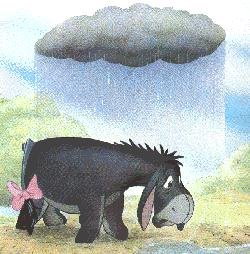
God bless my wife and best friend Holly Huckeba, who yesterday did convince me to manhandle and operate a rented drain auger to open up our clogged laundry drain, even though I was initially very much opposed to this plan, and did complain loudly, and with much bitterness and consternation, and did say that I thought it would never work (though not in an Eeyore voice, nor with any little rain clouds floating over my head).

Indeed, this course of action was MUCH LESS EXPENSIVE than any previous course of action and as a direct result of this drain clearing success, I am feeling VERY BUTCH today.

Huzzah!

Tagged , , , , , ,

Texas Vacation: Pictures for All Y’All to Look At

This was probably one of the best Huckeba family reunions ever.

The weather was great (once we got used to the suffocating Texas heat and humidity), Aaron and Kennedy managed to form great gender and age constellations with their cousins (some reunions include much bitterness and gnashing of teeth over who will get to hang out with the cool older cousins, but this year all the cousins seemed to be tipping the cool scales), and Texas holds just the right mix of unhealthy but tasty foods (TexMex and BBQ) and exciting but dangerous familial activities (Aaron and I fired a variety of weapons at a shooting range, including an M4, and you can buy inexpensive bottle rockets and packages of exploding mortars called “The 10 Banditos” which includes a warning in the package that reads: FLAMING BALLS OF FIRE WITH REPORT).

What more could you ask for in a reunion?

7-7-2010 090

7-7-2010 001

IMG_1556

7-7-2010 194


IMG_1646

IMG_1564

7-7-2010 214

More pictures at flickr.

Tagged , , , , , , , , , , ,

Tim Elhajj in Together Magazine

I’ve got a piece up in Together, a new recovery oriented newspaper for the New York area. I’m revisiting the James Frey boondoggle, but looking at it from a new (I hope) perspective. Check it out: The Millionth Word on “A Million Little Pieces.”

Together appears online and in print. I just got my print copy, and it looks like a gas, not just for people in the recovering community but for anyone interested in a more healthful, contemplative life.

Tagged , , , , , , ,