A Serious Car Repair Question

So my old BMW Series 3 was creamed by a trash truck in the summer. I can still drive it. But it was too old to get repaired, so I frittered away the insurance money on whatever.

Now, however, I have a problem.

My trunk is filling up with water! Whenever it rains, the trunk fills with water. There is no drain plug to drain some parts of the trunk, particularly the little space behind the wheel well on the drivers side. How annoying is this?! It turns out that in the back fender that got smashed there is a little vent that normally vents the gas tank but the fender around this vent is now mangled in such a way that the vent is allowing water into my trunk at an alarming rate.

So. What are my options?

  1. Do nothing.
  2. Bail the trunk out every few nights.
  3. Jam a towel into the vent.

I tried option #1 for the longest time. But it did not work. Now the carpets in the backseat are soaked with water.

I tried option #2, but this is the Pacific Northwest and it’s rainy season. I can’t keep up!

I am now on my last option: #3.

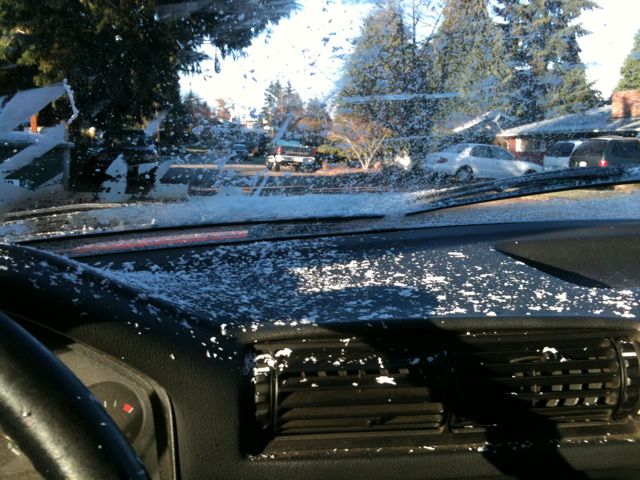
However, the cold has descended onto the Pacific Northwest so now the towel is frozen in place. There are little ice stalagmites hanging from the bottom of the trunk hood. I have to pry the trunk up to look inside. There is so much moisture in the cabin of my car, I have to scrape the outside and the inside of my windshield to drive. Of course, this is all terrible. I am just going to get a new car.

Meantime, I have one question: Is there any chance that by plugging the vent to the gas tank with a frozen towel that the car might blow up, resulting in a fatality?

No really. Serious question here.

Tagged ,

Gary Presley in the New York Times

My writing group companion and friend Gary Presley has a Modern Love essay appearing in the New York Times this week. Congratulations Gary!

It’s a real winner. Here’s a little taste:

And so it was that the man in a wheelchair, sardonic and standoffish, and the vibrant young woman who loved science and worried over how she would support her sons, developed an odd connection, a link to a place where hands might touch, but thoughts and feelings and emotions began to flicker like lightning beyond the horizon.

More…

Do you have your own Modern Love story you want to submit to the New York Times? Here’s how you might go about it.

Tagged , , ,

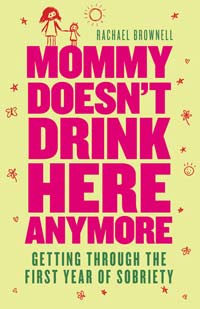
Rachael Brownell’s Mommy Doesn’t Drink Here Anymore

mama-no-drink-here-no-mo-yo

I’ve done a ton of summer reading that I probably won’t ever find time to write about (especially since it’s Nov), but I wanted to push Rachael Brownell’s debut memoir to the top of the list. I loved it. I watch for recovery memoirs, but had no idea about Ms Brownell or her book until I found a small stack of Mommy Doesn’t Drink Here Anymore at one of the big independent book stores in Bellingham.

I am glad I found it.

A fast paced romp through the first year of sobriety, it’s a pretty quick read. Brownell knows how to tell a story. At the end of an early chapter, I found myself astonished at the lengths she was willing to go to carve out a safe place for herself and her children. I don’t want to spoil it, but Brownell is one of those indomitable people whose presence just leaps off the page. Motherhood triggers her descent into alcoholism, although this isn’t a sordid tale by any standard. She used crisp white wine to unwind in the evenings, until eventually she felt the wine had her.

This memoir is notable for its realistic focus on recovery in 12-Step programs. Most recovery memoirs include an obligatory mention of attendance at some sort 12-Step meeting. Some offer critiques of 12-Step programs, while others offer breathless details about the anonymous lives the author finds there. Most of the time I get the impression that the meetings weren’t all that important to the story. Certainly attendance at 12-Step meetings isn’t the only way to get sober. But I always feel a little skeptical about recovery stories where the addicted person’s salvation comes through the love of a good man or woman.

Mommy Doesn’t Drink Here Anymore isn’t like that at all. It’s not a testimonial, but more like a celebration of 12-Step recovery, as told through the eyes of a grateful newcomer, who is charmed and appalled in equal parts by what she finds in meetings: the 12-Step lingo, the corny slogans, and the member’s oft stated reliance on a Higher Power.

Read it. You won’t be disappointed.

Tagged , , , , , ,

Love Hurts: Betrayal in Memoir

love-hurts

At last month’s reading, someone asked how you protect siblings when writing memoir. It’s a good question and I didn’t feel I had a great answer. When you write about your life in essay or memoir, you naturally lean toward things that have some emotional weight: the people, places and events in your life that have had enough heft to have left a mark. Often these things involve family members—whether siblings, mates, parents or children.

This is where it can get sticky.

I don’t think it’s possible to write good memoir without betraying someone. Memoir requires we put ourselves on the line like no other kind of writing. Here I am not thinking of only the scandalous tell-all memoir, although it’s certainly a fine example of betrayal. But even stories about the most ordinary subjects—parenting, infirmities, relationships (especially relationships!)—require unearthing details that wouldn’t ordinarily be a part of the public sphere.

I first realized this after having a conversation with my nine-year-old son about sex. He and I had sort of stumbled into the discussion, but it ended up being one of the most satisfying parenting experiences I’ve ever had.

So naturally, I wrote it up and posted it to my blog.

I didn’t think about betraying anyone as I wrote. To me, the story was about my reluctance to tackle my fears and inadequacies around being a good father. But to tell the story, I had to mention that my nine-year-old had found pornography on an old laptop computer that I had earlier lent to my oldest son, who had been stationed here in Seattle. I suppose I understood it was a little dicey to link my oldest boy’s possession of the computer and pornography, but there seemed to be enough plausible deniability built into the story (he shared the computer with all his roommates) to cover everyone, so I blazed forward.

When I finished, I posted the story. Friends and family were amused. I was pleased. One night as I read the comments attached to the story, my nine-year-old noticed it over my shoulder. He was reading dialog attributed to him, that he had actually said.

“Is that about me?” he asked.

I could hear the hurt in his voice. We had had a heart-to-heart talk—one of our very first—and I had posted it to the Internet for all to see. I felt so ashamed. I quickly switched the window to something else. It was all I could do not to just tell him a lie: “You? Of course not.” Somehow I held my tongue.

Now parents have been telling humiliating stories about their kids for ages, so that’s nothing new. But this story was different—it wasn’t about getting a cheap laugh. I wanted to talk about coming to terms with my fears around being a parent.

My nine-year-old and I needed to have another little heart-to-heart.

I didn’t try to explain to him anything about fears and inadequacies. I went with how much I love to write. He seemed to understand that I wasn’t out to hurt him. We came up with some boundaries, which mostly involved certain things he would rather I never write about, if they involve him. 

My big lesson was this: it’s fine to write about the important stories, but you have to consider the aftermath. Can you live with it? I know writers who have changed the names of their loved ones to protect their privacy. I have heard of other writers who have let loved ones (and even not so loved ones) vet their pages before publication, with the option to negotiate what details get published. Obviously if you’re writing a tell-all memoir, you’re not going to have the pages vetted, but you must prepare yourself for the potential fall out.

A few months later my oldest son posted to the comments section of my blog denying any knowledge or complicity with pornography, which I had already assumed was the case, anyhow, but his earnest disavowing also made me chuckle. We probably need our own little heart-to-heart, but he already knows how much I love to write, how important our relationship is to me.

He is my biggest fan. Somehow my best stories always seem to be about him. Writing memoir is almost certain to involve betrayal, but that’s not always so bad.

Sometimes it can be the start of something beautiful.
Tagged , , , , , ,

Seattle Book Fest: A Big Success

stack

Last night’s reading at the Seattle Book Fest was fun.

I surprised myself by getting nervous about three hours before Matt and I spoke. Holly said you couldn’t tell from listening to me, but I don’t see how that’s possible. The good news: I didn’t faint or throw up.

We were talking about flash non-fiction, so I read I Am and Jimi Don’t Play Here No More. I thought my first story, “I Am,” went really well. Halfway through Jimi, I just wanted it to be over. 

But I kept reading.

Fortunately for me, Matt was there. What a pro! I’ve attended enough of these panels and workshops to know what’s expected, but each time Matt interjected something helpful, it seemed like a revelation:

“Can everyone hear?” “Is anyone interested in learning where to submit their own flash for publication?”

In the end, it seems like it’s the simple, obvious stuff that makes or breaks a good reading. I am pleased I was able to participate. Once I started writing, it took me a long time to start sending things out for publication, but it was an obvious next step, and one I’m glad I finally took. Now I’ve done my first reading. I just need a book deal (and maybe a groupie) and then I’ll be solid.

All kidding aside, I want to thank Matt Briggs for allowing me to read with him. What a great opportunity.

Thank you, Matt!

Tagged , , , , ,

Jason and the Argonauts, a Ray Harryhausen stop-motion masterpiece

I recently watched the Ray Harryhausen stop-motion masterpiece, Jason and the Argonauts, with the kids. The movie still delivers. The kids loved it.

Holly has been introducing the kids to classic movies and TV. I haven’t participated much, mostly because I haven’t been too interested in the picks—wacky old comedies, like Spaceballs or the old Pink Panther. The kids have never enjoyed movies too scary or intense. But if their recent reaction is any indication, some of that is changing. I thought it might be fun to post their reaction to my picks, for better or worse.  

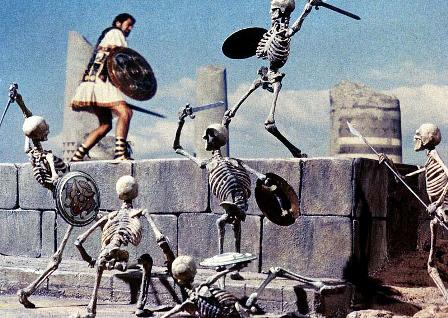
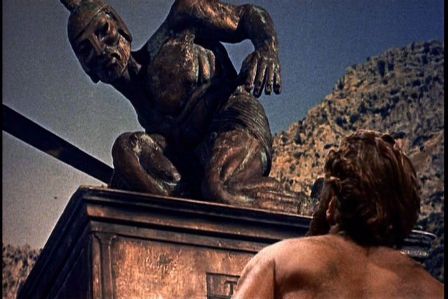
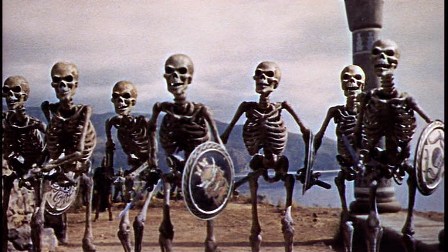
I was astonished to learn that Holly had never even seen Jason and the Argonauts. This 1963 film features some of the most compelling monsters in any film, even compared to modern films with advanced special effects work. I am not sure why this is. I suspect it has to do with the special effects being just real enough to suspend disbelief, but not so real as to make you squeamish. I love the grand finale battle with the skeletons and the first battle with Talos, the giant copper titan come to life. It may also be because the special effects that don’t work so well are cheesy enough to make you laugh—think: Jason’s battle with the multi headed hydra (especially when it has him coiled in its tail), and Poseidon, the giant sea god, who calms the Clashing Rocks.

The kids watched with one of their friends. All the children enjoyed the battles and special effects, but Kennedy and Aaron were particularly impressed by the Greek mythology. This is probalby because they’ve been enjoying the Percy Jackson series of books. Their friend hasn’t been reading Percy Jackson and his attention wandered, especially during the scenes featuring Greek gods looking down from on high.

Tagged , , , , , ,