Tag Archives: memoir

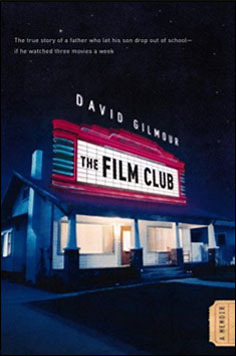
David Gilmour’s, The Film Club

film_club

I read David Gilmour’s, “The Film Club,” this weekend on a little mini get away with Holly and couldn’t put it down. I am a sucker for memoir, especially father and son stories and Gilmour delivers. The hook is that Gilmour’s teenage son starts to do terribly in high school, so he lets the kid drop out, if he promises to watch 3 films a week that Gilmour picks.

You hear that and think, “What? Are you out of your mind!”

Gilmour is the first to admit that it may turn out poorly. He agonizes over whether he is fucking the kid up or saving him, which to me seems like a pretty accurate description of parenting, although most parents won’t ever have to go to the lengths Gilmour did with his child.

The book rises mostly on Gilmour’s willingness to discuss his own inadequacies and fears about the situation. The love he has for his kid is just palpable. You can easily relate to the position he finds himself in, especially if you have a strong willed child of your own. Interestingly he doesn’t try to do anything didactic with the movies he picks. He loosely organizes them into “units,” but these groups of film sometimes seem pretty arbitrary–“The Quiet Ones,” a collection of first time actors who steal the show–to pretty obvious collections (Horror, Guilty Pleasures, etc). He mostly provides mentoring and companionship for his son who goes through a period where he is board with school and trying to figure out his place in the world.

If the book has a flaw, it’s that you occasionally want to reach through the pages and swat the kid, just to see if the heavy hand of discipline might not work a little faster. Fortunately for Gilmour, he knows how to tell a story. And he has a seemingly endless supply of cool insider stories that he can trot out. He is a thoughtful writer who easily relates the movies he’s watching to what is happening in his life and his son’s. And it doesn’t hurt that he comes off like a real man’s man.

It just really works. If you get the chance, read it!

Tagged , , , , ,

In Defense of Big Jim: Another Look at the Million Little Pieces Controversy

 oprah_frey_0513

After recently reading that Oprah has apologized for rebuking James Frey, I felt encouraged to write up my thoughts about Million Little Pieces, Frey’s controversial memoir about drug addiction that includes many fabricated details. I hadn’t done it earlier because, frankly, I didn’t want to be in the James Frey apologist camp. I find the fact that he made up so many details about his recovery incredibly sad. I say this because he offers such an accurate and compelling portrait of a certain type of recovering addict—almost an archetype—that has been in every treatment center I’ve ever been in. And I’ve been in a quite a few.

I started using heroin when I was 17. When I was about 23, I made my first attempt at inpatient treatment and over the next four years I participated in five more attempts. These included stays at different types of inpatient facilities, including the secular and religious; hospital and farm; big city and rural; 12-Step and Therapeutic Community. To understand where I’m coming from, you have to understand something about how treatment works. Each facility might have a different approach (sometimes wildly different), but there seem to be two constants across all programs:

  1. Clients can never engage in physical violence, or even threats of physical violence;
  2. Clients cannot have sexual or romantic relationships with other clients.

These are the cardinal rules.

Of the two, the rule about violence is probably the greater issue because this sort of behavior has the potential to affect the whole environment. You can’t foster the emotional depth required to right an upturned life, if everybody is attacking one another. The other rule prevents individuals from getting lost in the heady experience of a new relationship or just junking out on sex.

Now here is the interesting thing about these rules, or any rules: The disingenuous among us can often find ways to use the rules themselves to gain an advantage they otherwise might not be able to achieve. As you might expect, this is especially problematic in drug treatment. Once, during a stay in a religious facility in Syracuse, I met a young man who claimed to regularly receive prophecies from God. The facility was a charismatic Christian operation, and prophecy and other gifts of the spirit were part of the inpatient milieu. This young prophet was about eighteen, from a wealthy family, and handsome. He wore his hair feathered back like Bon Jovi and only received transmissions from God right after lunch, during the long, hot catechism classes that followed. His messages were almost always harmless aphorism. The first time it happened, I thought he was having an epileptic fit. We were all sitting at our desks and he began to shake, making his chair rattle. Soon he began speaking in an other worldly voice. You knew it was God speaking through him, because he used words like Verily and Thou.

I glanced over at Miguel, a drug addict from the Bronx about the same age as me, and rolled my eyes. The proctor, a slight man with soulful eyes, would wait patiently for these prophecies to end, his hands folded on the lectern. What else could he do? In this facility, Jesus was A-1 and to prophesy was not only condoned, but encouraged.

Religious institutions may offer unique occasions to subvert the rules, but the no violence rule offers a similar opportunity for everyone. Going into inpatient treatment can be an intimidating experience, especially your first time around. You’re suddenly thrust into the middle of hierarchy, where previously you may have never even understood a hierarchy existed. In an inpatient facility with strict rules about violence, you can’t just beat one another down to determine the Alpha. Instead, it’s all done with stories. Instead of uttering prophecy, a person might exaggerate his credentials. This might involve the kinds of drugs one used, the types of crimes one committed, or the length of time spent in jail. Because of the rules about violence, there isn’t a good way to sort out the liars. Typically this behavior comes from young men of wealthy families, during their first stay in treatment. Most of the time, it’s just ignored. With the rules in place, the risk of one client beating up another is nil. The greater risk is that clients posing as thugs will never come to understand themselves with any amount of depth.

This seems to be exactly what happened to James Frey.

Ignoring the two cardinal rules of treatment, Frey describes his treatment experience as a lot of tough posturing and a relationship. As I read Million Little Pieces, I kept thinking Frey had written a memoir from the point of view of an unreliable narrator. He seemed to have really captured the frightened little rich kid, desperate to prove his own worth. In treatment usually what happens is that the bona fide tough guys (you just know), start to openly explore their own fears and inadequacies. This is often enough to get the most hardened poser to come around and start being honest with himself (and everyone else).

I kept wondering when Frey, the recovering addict and author, would throw back the cape, renounce all the bluster and swagger, and show us who he really was. But I got to the end of the book, and it never happened. Maybe Frey couldn’t throw back that cape, because he had never had that experience in treatment. Maybe he never came to realize his own limitations.

Until Oprah hammered him on national television.

You can’t go through treatment six times without developing some empathy for people who fuck up spectacularly, especially other addicts. One afternoon in Syracuse, the Bon Jovi Prophet started to offer pointed messages critical of our entire class. The proctor listened calmly then asked him to remain after class for a private conversation. I have no idea what was said, but from that day forward the prophecy stopped. One assumes the proctor disabused this boy of the notion that he could speak for God.

What else could be done?

There is almost always a comeuppance in store for the addict who bends the rules too far to meet his own needs. Some of us just need a little more of a push to get to a more productive place.
Tagged , , , , , , ,

My Favorite Water Polo Game by Kennedy Elhajj

8-8-08 048

Here at Present Tense we’re mightly proud to present a memoir by Kennedy Elhajj.

Not only is this Kennedy’s first published work, it’s her first shot at writing memoir. This essay is the result of a fifth grade project done by her entire class. The press is claiming that she fabricated parts of this non-fiction essay, but don’t you believe it. As her father, I can vouch that every word of it is true. My little girl is the real deal.

8-24-08 031

My Favorite Water Polo Game
by Kennedy Elhajj

The swimmer was racing toward me while my teamies swam their hardest behind him. It was all up to me now, I was GOALIE! It seemed like slow-mo.

The ball came racing toward me! I WAS TERRIFIED! I tried to tread my hardest; it felt like my legs were going to EXPLODE! The player got ready to cheer. Then… SPLASH! I went underwater. A mysterious pain throbbed in my hands. When I bobbed to the surface my eyes were covered in water. When my eyes cleared the first thing I saw were my teamies cheering.

There was 1 second on the clock! I felt rushed; the score was 10-10. I looked behind me expecting to see the ball. But it wasn’t there; I looked in front of me. THERE IT WAS! The ball was sitting right in front of me!

I was proud and excited at the same time. I had saved the game, I felt good. The clock blared as loud as a siren.

The crowd stood up and cheered. I had saved the game, I felt very powerful at that moment. I got lots of hugs and kisses (even Aaron gave me a hug, when we got home of course, and that made me feel extra good).

But back to game! I got high 5’s from my teamies.

As it turned out my dad had taken a picture of me saving the goal, he took another picture of me and Aaron shouting at each other (after the goal) in a good natured, happy way. My dad made a joke about it and I laughed so hard, that when I was done laughing I was out of breath.

That was my favorite water polo game ever.

THE END

Tagged , , , , , ,

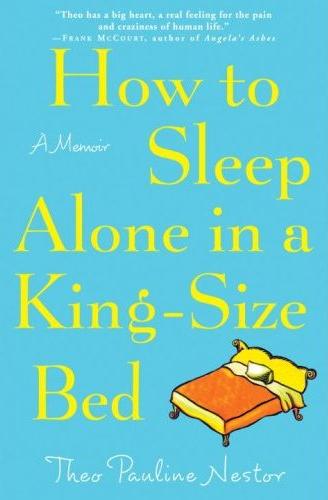
How to Sleep Alone in a King-Size Bed

The last good book I read was Theo Nestor’s divorce memoir, How to Sleep Alone in a King-Size Bed.

I can’t remember ever reading another memoir about divorce, but I enjoyed this one. The first chapter is essentially the Modern Love essay Theo wrote for the New York Times. The feedback she got from publishing her essay actually plays a small role in her transition from married to single mother. I wish the first chapter to my memoir would present itself to me in similar fashion, but no such luck.

Theo mentions that thing Dad would occasionally do when he and Mom were arguing. Dad would say, “If this were the Old Country, I could clap my hands three times and you would be divorced.” Sometimes Dad would even clap his hands once for effect. Theo says that’s a Sunni tradition, but I wonder if it isn’t pan-Arab. Dad was Catholic and he seemed pretty familiar with it.

Of course, Mom didn’t care about any clapping hands nonsense. She would just shrug her shoulders and say, “This ain’t the Old Country.”

Tagged , , , , ,

Shalom Auslander at Elliott Bay Books

Shalom Auslander appeared at Elliott Bay last night to promote the paperback edition of his memoir, Foreskin’s Lament.

What struck me most is how serious and intense he is. I guess I should have realized this about him from his promotional photo, which simply screams I am a serious and intense author. But his work, which I love, just seems much too funny to come from anyone so grave.

Except for a single man who laughed loudly in all the right places, the reading felt a little like a wake. Despite this, I enjoyed myself. I got a chance to hang out with Matt Briggs and talk shop. And it’s always good to get into Seattle for a night.

Auslander said he considers memoir to be the literary equivalent of pornography. I’m pretty sure he was serious. I guess he only wants to write fiction, but his memoir is really good.

Tagged , , , , , , ,

How I Got My Story Published in the New York Times: The Truth of the Matter


When Dan Jones of the New York Times called about publishing one of my stories for Modern Love, I was delighted. I was also determined not to let him know I had a drug history. Dan had emailed me that he thought my story might work well for Father’s Day and wanted to discuss it more by phone. I immediately thought: Don’t tell him about the drugs. He’ll think you’re a loser. But then when he called, we talked for less than five minutes before my drug history came up.

It went something like this:

“So if your son was in Pennsylvania with your ex-wife, what were you doing in New York City?” Dan asked.

I chuckled demurely. Lying seemed like a bad idea.

“Well,” I said taking a deep breath. “That’s another story.”

Continue reading

Tagged , , , , , , , , , , ,

The Truth About David Sedaris

Last month Holly and I got to see David Sedaris at Elliott Bay Book Company here in Seattle. He was promoting his latest book, When You are Engulfed in Flames, which is a collection of previously published essays and some new material. The most enjoyable part of the evening had to be the Q&A session after he read, and this is only because David Sedaris is so witty and fast on his feet. The truth about David Sedaris is that he is arguably one of the best American humorists writing creative non-fiction today, but he has also been criticized for stretching the truth in his work.

Continue reading

Tagged , , , , , , , ,

After Life

If you’re interested in memoir, you might enjoy After Life, a Japanese film from about ten years ago.

The setup is that when you die, have three days to pick a memory that will then be turned into a film. This film then accompanies you into all eternity.

Much of the movie is shot as a documentary, so it’s a little slow in parts. There are counselors in this stage of life, who are tasked with helping the newly dead decide on a memory. There is no judgment hour in this hereafter. One of the new guys even makes a joke of it. “What, no hell? This is it?”

If there is no hour of judgment, the counselors do their best not to judge the dead people either, but this is where the film really shines. You can’t help but judge the people as they reveal themselves through their memories: one is a prostitute, another a lecherous old man (If you wait to pick your prostitute until 11 O’clock, you get a better bargain!), another a boring old man.

At least, I felt justified sizing up each of the newly dead, based on their memories. But as I watched the story unfold through the character’s memories, I realized not everyone is who they might seem. The memories are all true, but the context is everything.

Tagged , , , , ,

Wolf at the Table

I came to Augusten Burroughs work through Dry, a memoir about his struggle with alcoholism, which is somehow both heartfelt and funny. Then I read Running with Scissors, his quirky coming-of-age story. Wolf at the Table is completely different from the earlier works, exploring Mr. Burroughs’ relationship with his father, an emotionally distant alcoholic. It would be an understatement to say Mr. Burroughs finds his father lacking: His bitterness is so palpable, the book is hard to read.

I love memoirs that explore fatherhood. In the 50s and 60s, fathers were almost always depicted as good and wholesome. As I kid, I could see my old man didn’t add up. How could he? Those depictions had little to do with reality. Nothing bad about Dad was every explored. Now we get something like Wolf at the Table, but this father is so clearly and irredeemably bad, it’s almost like a throw back to thin view of fathers from the 50s and 60s (albeit the other side of the coin). Burroughs father is as bad as Father Knows Best is good. How’s the for coming full circle?

You have to feel bad for any adult lugging around so much resentment from childhood. One good thing about being a rebellious child: With my family, I always managed to keep the resentment ledgers pretty even. If you give as good as you get, you never have to feel bitter.

Tagged , , ,

Inching Toward Publication

07-05-2005 (137)

Some small success to report on the publishing front.

One of my stories has been selected as a finalist for an anthology about fathers, My Dad is My Hero (Adams Press, Spring 2009). My story is one of 53 selected, but only 50 will be published. I’ll find out in July or August if I made the cut. Keep your fingers crossed, people.

The story I submitted is an excerpt from a current post on the blog (the contract I signed allows me to continue to publish it here, even if it’s selected). And that post is actually an excerpt from a longer chapter in my memoir. It’s ironic that the the anthology is about heroic fathers: the full chapter from the memoir offers a somewhat different sensibility about Dad, or at least it juxtaposes a heroic Dad against a more needy Dad. Despite this irony, Dad still makes out pretty good in my memory (as he does in my book).

If you’re wondering (especially you people at home), my childhood memoir isn’t meant as an attack on Dad or anyone else. The more I write, the more I learn about the story, but from what I can tell right now it’s learning to appreciate your own talents and sensibilities, instead of trying to be someone you’re not.

If you want a memoir that’s an attack on fatherhood, read Augusten Burroughs’s Wolf at the Table. I’m only 100 pages in, but Mr. Burroughs is so bitter with his father, it’s hard for me to read.

Tagged , , , , ,